
6 Face Shapes and the Best Earrings to Flatter Each One

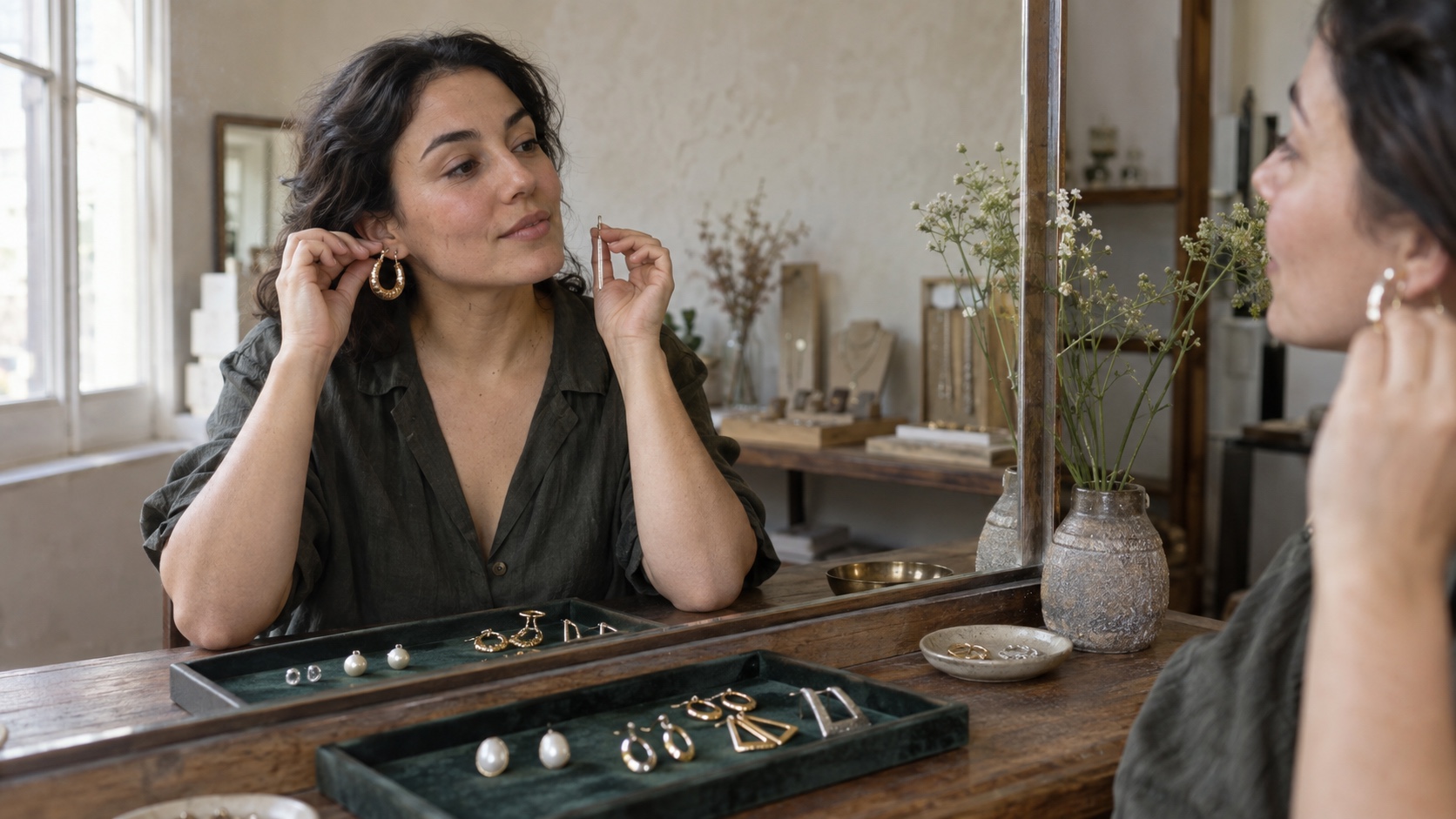
The most useful way to choose earrings for your face shape is to decide whether you want contrast or repetition. Curved earrings can echo soft contours, angular designs can repeat a defined jaw, and long drops can add a strong vertical line. None of those effects is inherently more flattering than another, so treat this guide as a set of six starting points rather than a test you have to pass.
Our picks use the same criteria for every face shape: where the face appears widest, how long it looks relative to its width, where the earring places visual weight, and whether its scale feels comfortable. Hair, glasses, neckline, and personal style can change the overall composition just as much as face shape. Clip-on earrings, studs, hoops, cuffs, and drops all belong in the comparison.
The Lowdown on Face Shapes

Face-shape labels describe an outline, not a person. In a straight-on mirror view, notice the relative width of your forehead, cheekbones, and jaw, then compare the apparent length and width of your face. Oval, round, square, heart, diamond, and pear or triangle are common styling terms, but real faces often sit between categories.
That ambiguity is not a failure of your mirror. A 2025 morphometric study found poor agreement among observers using a conventional face-shape classification system, with the strongest consensus only for round and oval categories. Earlier research likewise noted that two people can assign different labels to the same face. If two descriptions seem plausible, test the earring suggestions for both and keep the effect you prefer.
Then look at the jewelry itself. A stud keeps visual weight close to the ear. A hoop repeats a curve and adds width around its widest point. A narrow drop introduces a vertical line, while a teardrop or fan places more weight at the bottom. Those are visible design choices, not promises to correct a feature.
Oval Face: The Most Flexible Starting Point

Best starting point: medium-scale earrings with a clear shape, such as sculptural drops, classic hoops, or substantial studs. An oval face is typically longer than it is wide, with a curved outline and a jaw narrower than the cheek area. Because no single horizontal zone dominates, many earring silhouettes sit comfortably beside it.
Use that flexibility to support the outfit rather than chasing a universal best earring. A compact hoop keeps the look balanced; a long narrow drop emphasizes length; a wide statement piece shifts attention toward the ear. If your face reads as both oval and oblong, try shorter drops or wider shapes when you want less vertical emphasis.
Clip-ons work by the same visual logic as pierced earrings. Check the scale and placement, then wear them long enough to judge pressure. A beautiful pair that pinches after ten minutes is not the right choice for an all-day look.
Square Face: Curves for Contrast, Angles for Emphasis

Best starting point: rounded hoops, oval drops, or fluid shapes when you want contrast with a broad, angular jaw. A square face usually appears similar in width at the forehead, cheekbones, and jaw, with a length closer to its width than an oblong face. Soft curves make a useful counterpoint because their outline is visibly different.
Contrast is only one strategy. Rectangular studs, architectural drops, and angular cuffs can repeat the jawline and create a sharper graphic look. That is not a styling mistake; it is emphasis. Decide whether you want the earring to soften the composition or underline its structure.
Length matters more as a placement choice than as a prohibition. A drop ending exactly at the broadest part of the jaw adds visual activity there. Choose a shorter or longer endpoint if you want the eye to land elsewhere, but keep the pair if that jaw-level emphasis is the effect you like.
Round Face: Add Direction Without Hiding the Curves

Best starting point: slim drops, narrow rectangles, or other earrings with a strong vertical direction when you want contrast. A round face reads as close in length and width, with a curved jaw and relatively few sharp changes in the outline. A linear earring does not change that anatomy; it simply places a different line beside it.
Contrast does not require a ban on hoops. Medium hoops can echo the face's curves and produce a cohesive, playful effect. Angular studs can add a small point of contrast without the movement of a long earring. The better choice depends on whether you want direction, repetition, or minimalism.
Scale the drop to your neck length and daily routine. Shoulder-grazing earrings can catch on collars, headphones, or hair, while a shorter linear drop delivers much of the same visual direction with less movement.
Heart-Shaped Face: Try Weight Lower in the Earring

Best starting point: teardrops, fans, and chandeliers that widen below the earlobe. A heart-shaped face is generally read as wider through the forehead or cheek area and narrower toward the chin. An earring with more visual weight at its lower edge creates an easy counterpoint to that taper.
Keep the widest part of the earring where you want attention. A compact teardrop adds a subtle lower curve; a long fan makes the contrast more dramatic. If you prefer to repeat the face's taper, reverse-triangle studs or narrow drops can make that geometry the point instead.
Heart and inverted triangle are sometimes used interchangeably in styling guides, but labels vary. Focus on the width pattern you actually see rather than forcing your face into a single diagram.
Diamond-Shaped Face: Balance Movement Around the Cheekbones

Best starting point: curved drops, fans, or earrings with movement below the cheekbone. A diamond-shaped face is commonly described as widest at the cheekbones, with a narrower forehead and jaw. A fan or softly rounded drop moves the earring's visual weight below that widest point.
Short hoops and studs are strong alternatives when you want the cheekbones to remain the main feature. Very wide earrings at cheek level repeat the widest horizontal line; that can look boldly intentional, while a narrower drop creates contrast. Neither option is automatically more flattering.
Watch the earring in motion as well as in a still photo. A rigid geometric piece holds its silhouette; chains and articulated fans change shape as you turn your head. Choose the behavior that fits the setting as well as the outline.
Pear-Shaped Face: Keep the Focus Near the Ear or Echo the Jaw
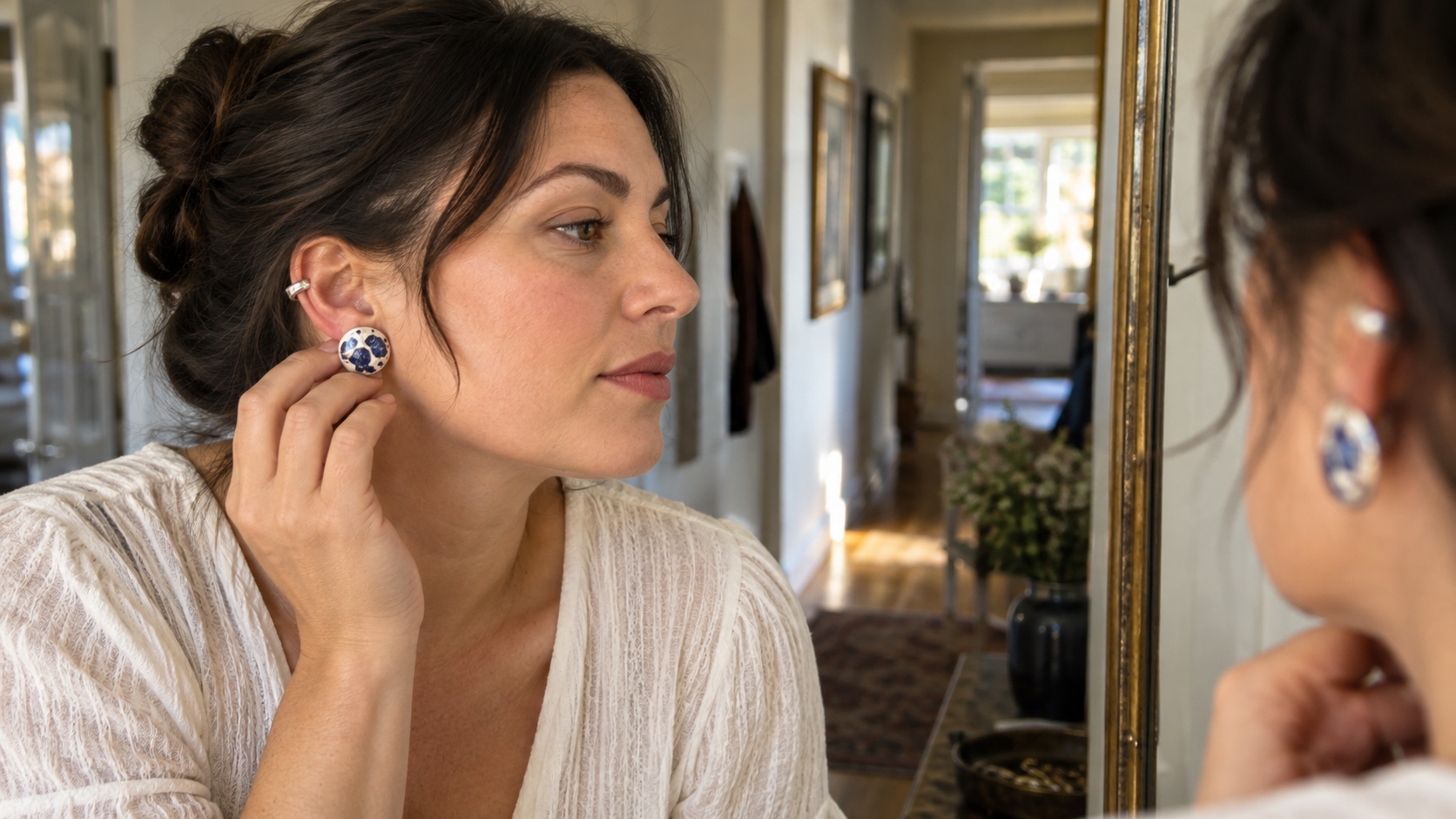
Best starting point: statement studs, compact clip-ons, and ear cuffs when you want visual interest higher on the face. A pear or triangle face is generally narrower through the forehead and wider at the jaw. Keeping the main shape close to the ear places the focal point above that widest lower line.
A narrow drop can add length without much horizontal weight, while a broad bottom-heavy earring repeats the jaw's direction. Again, repetition is not wrong. It can look strong and sculptural, especially when the shape also connects with a neckline or collar.
Clip-on earrings are a format, not a single style: they come as studs, hoops, drops, and statement shapes. Test the mechanism for comfort and security. If any earring causes itching or a rash, stop wearing it; the American Academy of Dermatology notes that earrings and earring backs are common sources of nickel exposure for people with nickel allergy.
Wrapping Up: Your Preference Beats the Diagram

Use face shape to narrow a crowded jewelry tray, then try the finalists. Check the pair from the front and side, move your head, put on your glasses, and test it with the neckline and hairstyle you plan to wear. A mirror view of the whole outfit is more informative than a close-up diagram.
If you enjoy fashion as a system, our look at how the modeling industry shapes visual conventions provides useful context. Building an outfit on a budget? Pair the same trial-and-compare method with our guide to finding quality clothing at thrift stores.
The final rule is deliberately simple: wear the earrings that create the effect you want and feel good for the time you plan to wear them. Face-shape guidance can suggest a starting silhouette. It cannot decide your taste.
Sources and Fact-Check Notes
Reviewed September 21, 2026. The limits of visual face-shape classification were checked against the 2025 morphometric reliability study indexed by PubMed and an earlier study of qualitative and quantitative face-shape assessment. The styling principle that jewelry can either contrast with or emphasize facial lines is consistent with the Gemological Institute of America's historical discussion of jewelry and face shape; it is treated here as editorial advice rather than a biological fact. Nickel guidance comes from the American Academy of Dermatology.